

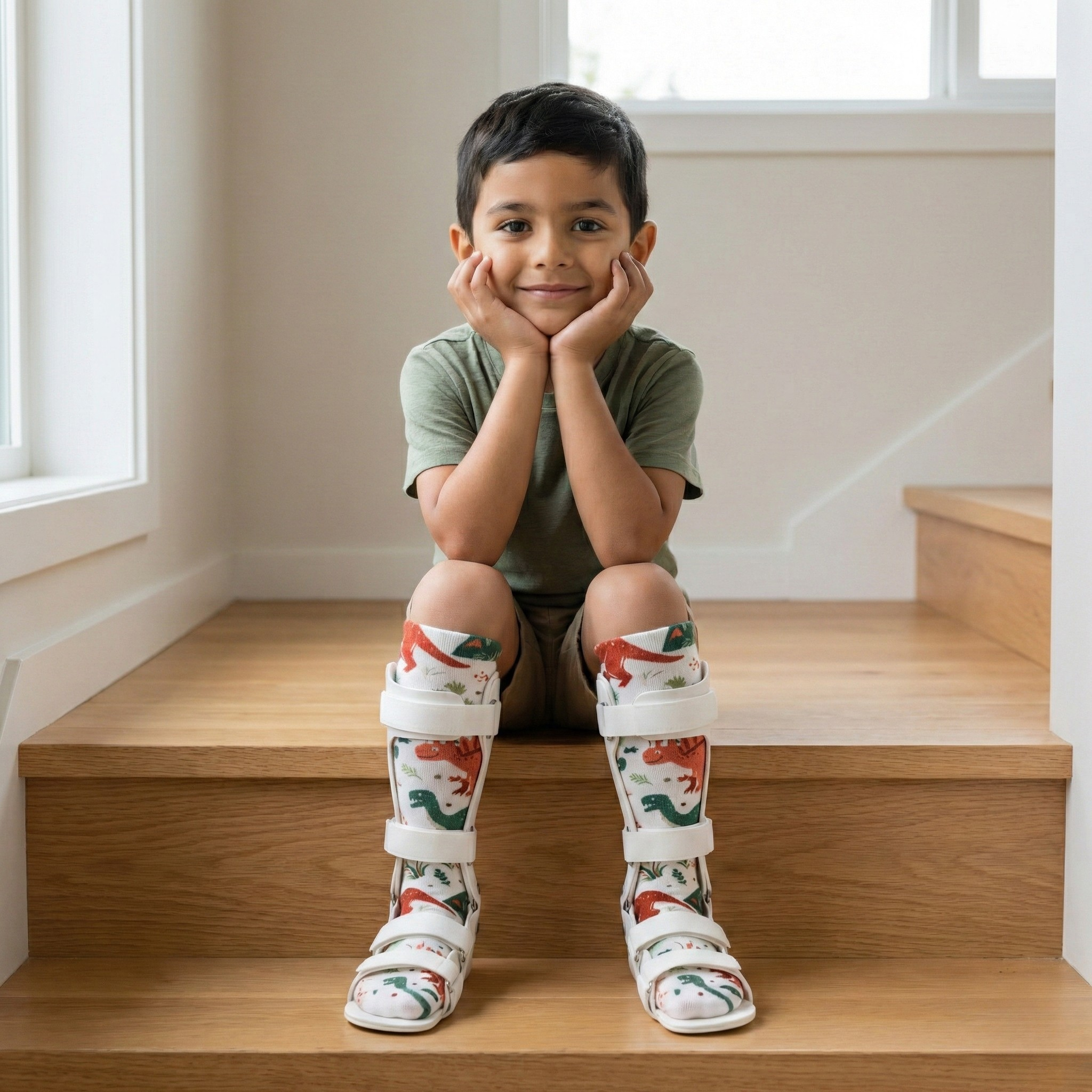
The best shoes for AFOs offer enough room for the brace, an accessible opening, and a secure, adjustable fit. For families, everyday details matter too: how easily the shoes go on and whether the child likes wearing them.
Finding a suitable pair starts with checking the shoes, AFOs, and socks together. This guide covers five practical features to look for, from opening design to sizing. Use it alongside your orthotist’s guidance for your child’s specific brace.
AFO-Friendly Shoes: Look at the Opening and the Fit
Shoes designed to accommodate AFOs can offer useful features, including extra depth, wider fits, and openings that simplify dressing. When comparing options, check how easily the shoe opens and whether it provides enough space for your child’s brace.
Zippers, adjustable straps, and laces serve different purposes and can work together. A zipper can provide access, while laces or straps help adjust the fit. Look for a design that opens sufficiently for the foot and AFO to enter without forcing them.
The best shoes for AFOs should be assessed with your child’s actual brace and socks. Check both the ease of putting them on and the fit once fastened.
5 Features to Check When Choosing the Best Shoes for AFOs
1. Check Length, Width, and Depth Together: Try shoes with your child’s AFOs and usual socks. The shoe needs room for the brace in all three dimensions. A larger size may be needed, but there is no fixed size increase that works for every combination. Compare widths and deeper styles, and ask your orthotist to help assess the fit.
2. Look for a Removable Insole: A removable factory insole can provide extra depth for an AFO. Ask your orthotist whether to remove it for your child’s shoe-and-brace combination, then check the fit with that setup. Keep any prescribed inserts or shoe modifications as instructed.
3. Check the Width and Opening: Wide or extra-wide options are worth trying, but also check how far the shoe opens. Look for a tongue that moves forward or a zipper opening that gives access for the foot and brace. Try the opening with your child’s AFO to see how easily you can put the shoe on.
4. Choose Adjustable, Practical Closures: Laces and adjustable straps can help secure the shoe around the foot and AFO. Some designs combine these with zippers for everyday opening and closing. Check that the fastenings close securely with the brace inside, and consider who will be operating them each day.
5. Check the Sole with Your Orthotist: Sole shape and heel height are part of choosing shoes to wear with an AFO. Follow your orthotist’s recommendations for your child’s brace, including any prescribed footwear modifications. Look for tread suited to everyday surfaces, and have the shoe-and-brace combination checked if you are unsure.

Choosing Socks to Wear with AFOs and Shoes
When trying the best shoes for AFOs, bring the socks your child will wear with them. Sock thickness and fit affect the space available inside the brace and shoe. Check that the fabric sits smoothly and provides coverage above the brace.
Lairos socks combine 90% cotton for a soft feel with 10% spandex for stretch. A defined heel helps with positioning, while a minimal toe seam keeps the toe join low-profile. Colorful printed designs add personality without loose internal pattern yarns.
Choose the appropriate sock size, align the heel, and smooth any folds before fitting the AFO and shoe. Let your child choose a print they enjoy as part of getting ready.
For more on daily skin checks and signs that need attention, see our AFO skin care guide.
Professional Guidance on Shoes for AFOs
The Royal National Orthopaedic Hospital recommends footwear with enough space to accommodate an AFO. Its patient guide highlights accessible openings, adjustable fastenings, and removable insoles that can provide additional depth.
Use these features as a starting point when comparing the best shoes for AFOs. Bring your child’s brace and usual socks to the fitting. Your orthotist can advise on the footwear features needed for their particular AFO.
Finding the Best Shoes for AFOs: Your Final Checklist
When choosing the best shoes for AFOs, check the complete combination: your child’s foot, sock, brace, and shoe.
- Room for the brace: Check length, width, and depth with the AFO inside.
- Practical opening and closure: Try putting the shoe on and fastening it with your child’s brace.
- Suitable sole: Follow the footwear guidance provided for your child’s AFO.
- Sock fit: Choose suitable coverage and thickness, then smooth the fabric around the foot and leg.
Once the fit requirements are met, make room for your child’s preferences too. Shoes they like and a favorite sock print can bring personal style into everyday dressing.
Lairos AFO socks combine a soft cotton-rich blend, stretch, a defined heel, and a minimal toe seam. Our printed designs add color without loose internal pattern yarns.
Explore our AFO sock collection to find a print your child loves and check the available sizes.


