

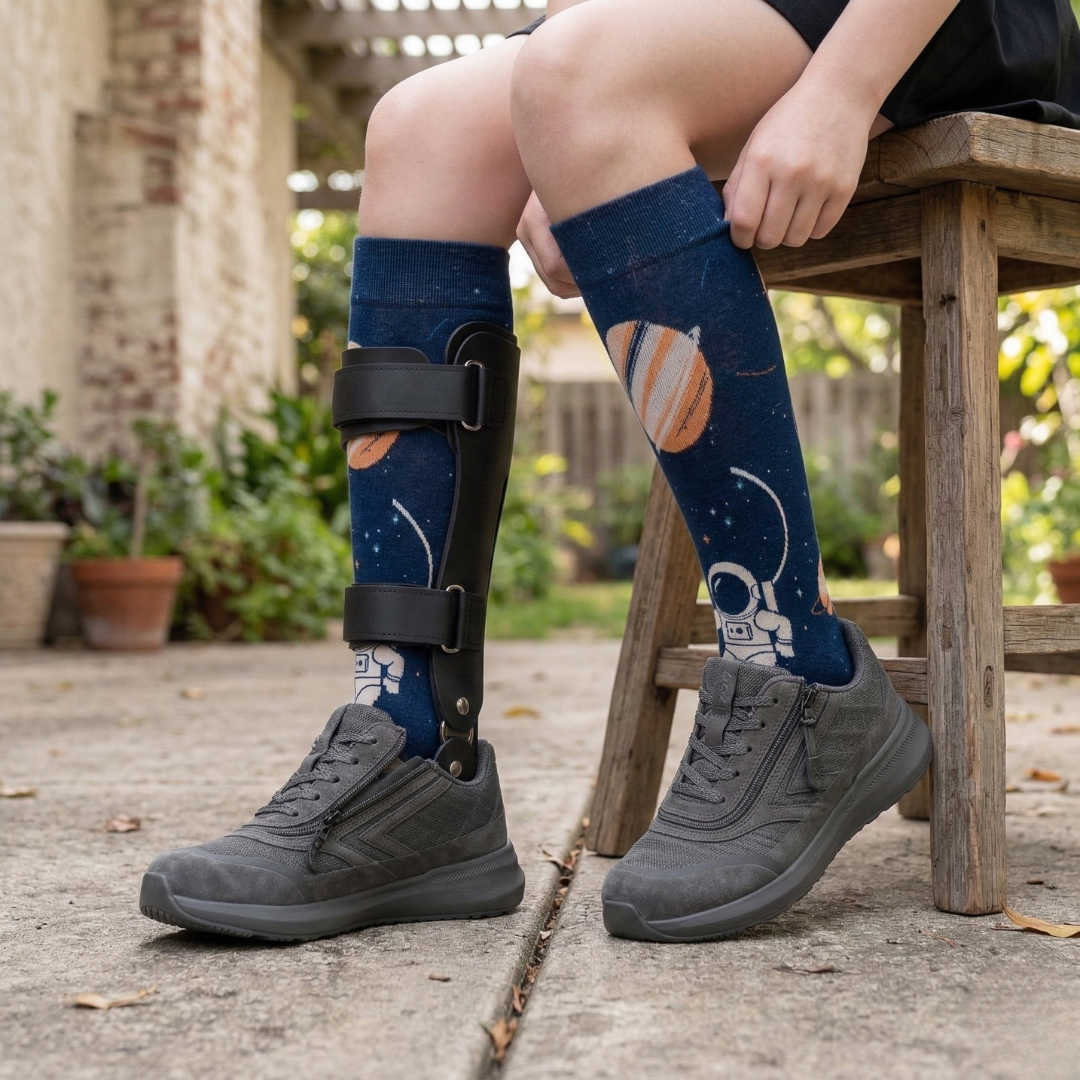
Choosing cotton spandex AFO socks for your child involves more than checking the fiber label. Consider sock height, thickness, seams, and fit, alongside how the fabric feels against your child’s skin. Follow your orthotist’s guidance when choosing socks to wear with the brace.
Lairos socks combine 90% cotton for a soft feel with 10% spandex for stretch. Our cotton spandex AFO socks also feature a defined heel, a minimal toe seam, and printed designs without loose internal pattern yarns. Together, these details bring fabric, fit, and personal style into the same pair.
This guide explains what to check when choosing cotton spandex AFO socks for your child.
1. Cotton vs. Synthetic Socks: Look Beyond the Fiber Name
When comparing cotton and synthetic socks, start with the texture your child enjoys wearing. Lairos cotton spandex AFO socks combine the soft feel of cotton with stretch from spandex. This makes them an option for families looking for a cotton-rich layer under a brace.
Moisture handling is another consideration when comparing cotton and synthetic socks. Cotton absorbs moisture, while some synthetic fabrics are designed for faster drying. If socks become damp, change into a fresh pair. Keeping a spare pair available can be useful on warm or active days.
For socks for AFO wear, look at the complete design: coverage above the brace, suitable thickness, a toe seam, and a fit that sits smoothly. Lairos brings these considerations together with a defined heel and printed patterns without loose internal decorative yarns. Check the size and fit with your child’s brace and shoe, following your orthotist’s guidance.
2. Why We Use 90% Cotton in Lairos AFO Socks
Cotton provides the soft feel at the heart of our cotton spandex AFO socks. We chose a cotton-rich blend for families who prefer this familiar texture against the skin, paired with spandex for stretch.
Comfort also depends on the finished sock. Knit texture, toe seams, and fit can matter as much as cotton content. For children with sensory sensitivities, check how the actual sock feels against their skin. Your child’s response matters more than the material label alone.
Thickness deserves attention, too. Look for a sock that fits comfortably within the space available in your child’s AFO and shoe, following their orthotist’s guidance. Extra thickness is not automatically more protective, and a sock should not be used to compensate for a brace that rubs or fits poorly.
For guidance on when to seek a brace review, North Tees and Hartlepool NHS Foundation Trust advises contacting the orthotics service if a child experiences discomfort or pain while wearing their AFO.
3. What 10% Spandex Adds to Cotton Spandex AFO Socks
Spandex adds stretch and recovery to our cotton-rich blend. Stretch helps the fabric accommodate the foot and leg during dressing, while recovery helps it return toward its original shape after being stretched.
In Lairos socks, spandex complements the soft cotton feel by adding flexibility during dressing. The defined heel provides a clear placement point, helping you position the sock around your child’s foot.
To choose your child’s cotton spandex AFO socks, start with the size chart. Align the heel pocket and smooth the fabric around the toes and ankle before putting on the brace. Selecting the appropriate size allows you to make use of the fabric’s stretch while keeping the fit suited to your child.

4. Spandex, Elastane, and LYCRA: What Do the Labels Mean?
Spandex and elastane are two names for the same type of stretchy synthetic fiber. Spandex is the term commonly used in the United States, while elastane is widely used in other markets.
LYCRA® is a brand of spandex fiber, not a generic name for every spandex yarn. The LYCRA Company explains this distinction in its guide to LYCRA® fiber. A label that lists spandex or elastane does not automatically mean the product contains LYCRA® branded fiber.
For Lairos socks, our stated composition is 90% cotton and 10% spandex. The phrase “elastic spandex” simply describes the fiber’s stretch quality; it does not identify a separate material or indicate a medical compression level.
5. Can Children Wear Sports or Compression Socks with AFOs?
Sports socks vary in height, thickness, cushioning, seams, and fabric. Some may suit your child’s AFO, while others may be too short, bulky, or uncomfortable. Check each pair with the brace and shoe. An “athletic” label or synthetic fiber content alone does not determine suitability.
Medical compression socks serve a different purpose from an everyday sock worn under a brace. If you are considering compression for your child, ask their healthcare team whether it is appropriate and how it should be coordinated with their AFO. If compression has already been prescribed, follow those instructions and consult the team before changing it.
Lairos socks are not medical compression socks. Their spandex content provides stretch, but they are not a substitute for prescribed compression garments. When choosing everyday AFO socks, focus on suitable coverage, a smooth fit, and comfort within the brace and shoe.
6. Lairos AFO Socks: Fabric, Prints, and Everyday Choice
Lairos combines a 90% cotton and 10% spandex blend with colorful printed designs. The patterns are printed onto the fabric rather than knitted with colored yarns. This avoids the loose internal pattern threads found in some patterned knit socks.
A minimal toe seam and a defined heel complete the design. The toe finish keeps the join low-profile, while the heel pocket helps you position the sock around the foot. These details complement the soft cotton feel and stretch of our cotton spandex AFO socks.
Style matters, too. Choosing a favorite print gives children a way to express their interests through something they wear every day. Our approach to design that inspires pride brings that personal choice into the daily AFO routine.
When choosing socks for AFO wear, start with the right size and check the fit with your child’s brace and shoe. Lairos brings together a cotton-rich fabric, thoughtful construction, and colorful designs for families who want practical details and personality in the same pair.
Explore our AFO sock collection to find your child’s favorite print and compare available sizes.


