

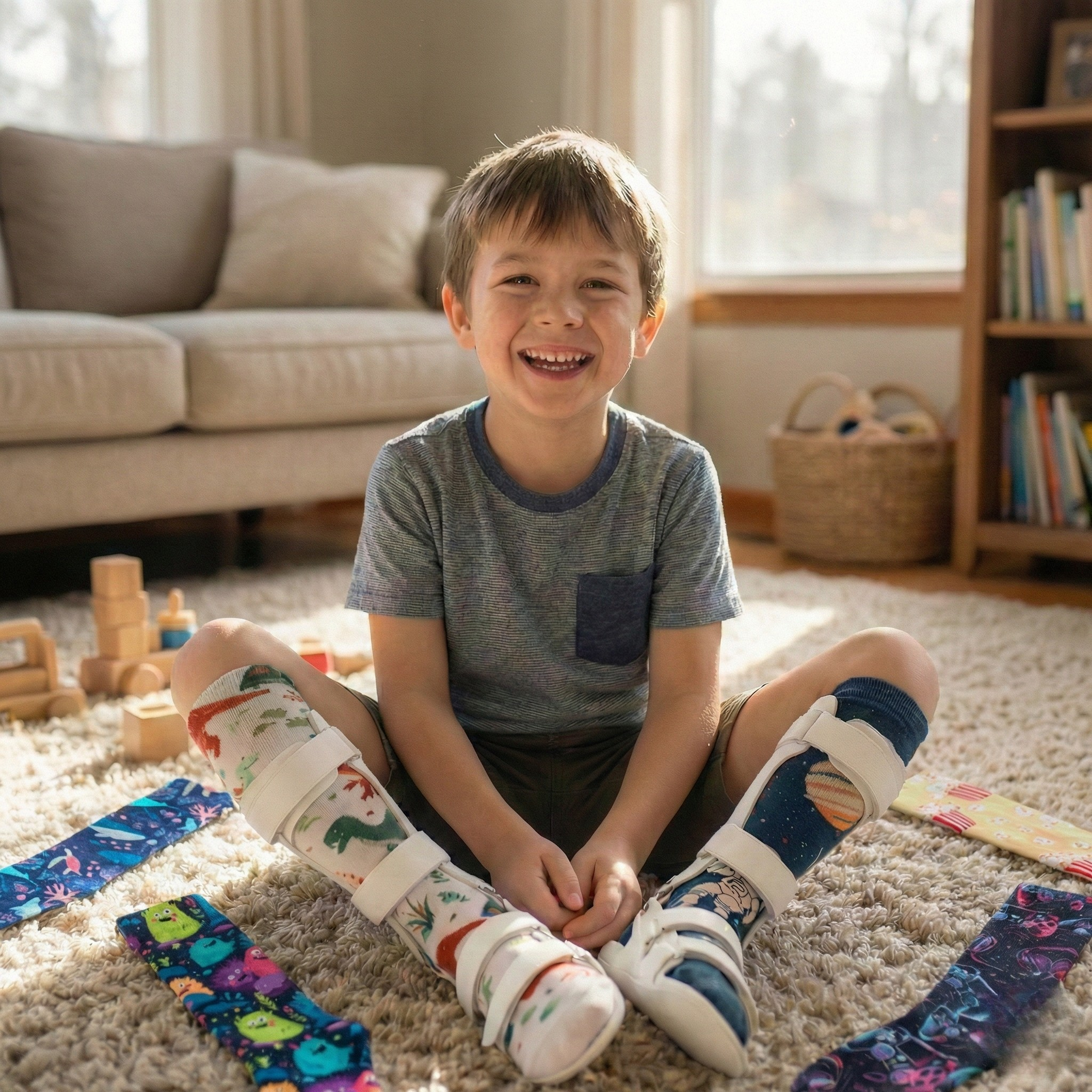
Finding the right AFO socks for your child is about much more than style. The right pair can support comfort, help reduce bunching and friction, and make the daily brace-wearing routine feel easier.
Not every knee-high sock is designed to work well under an AFO. Socks that are too short, too tight, too bulky, or made with prominent seams and loose internal threads may create discomfort inside the brace.
This guide covers five important factors to consider when choosing socks for AFO braces.
1. Look for Minimal Flat Seams and a Smooth Interior
For many children, especially those with sensory sensitivities, even a small seam can feel uncomfortable when it is pressed against the foot inside a brace.
The important difference is not simply whether a sock is described as “seamless,” but how prominent its construction seams are and where they sit.
Look for socks with minimal, low-profile seams that lie as flat as possible against the skin.
As we explain in our guide to why socks matter for AFOs, the way a pattern is created also matters.
Many traditional patterned socks use a Jacquard knitting method, which can leave decorative threads and floats inside the sock. These loose internal threads may feel rough or create uneven areas under the brace.
Lairos printed socks use dye-sublimation printing. The design is applied directly to the fabric rather than created with additional decorative yarns. This allows the inside of the printed sock to remain free of loose pattern threads and floats, while the sock itself uses minimal flat construction seams.

2. Consider Breathability, Softness, and Stretch
The fabric blend affects how the sock feels, stretches, and performs throughout the day.
Different families may prefer different materials. Synthetic fibers are often used for moisture management and durability, while cotton is valued for its softness and breathability.
Lairos socks are made from a blend of 90% cotton and 10% spandex.
The cotton-rich construction provides a soft feel and helps support breathability under the brace. The spandex adds flexibility and allows the sock to adapt to the shape of the foot and leg.
This stretch also helps the sock stay smoother and reduces the chance of slipping or bunching around the ankle.
The goal is not for the sock to feel tight or compressive. It should provide enough flexibility to sit comfortably under the brace without adding unnecessary pressure.
3. Choose the Correct Sock Height
An AFO sock should extend above the top of the brace.
This ensures that the skin is covered anywhere it may come into contact with the AFO, including around the upper edge of the brace.
Some families choose to fold the cuff gently over the top of the brace. Whether this is appropriate may depend on the brace design and the guidance provided by the child’s orthotist.
The most important point is that the sock should provide full coverage without being pulled so tightly that it creates pressure around the leg.
Check your child’s skin regularly and follow the instructions provided by their orthotist or healthcare team. If you notice persistent redness, blisters, or signs of skin breakdown, contact the professional who fitted the brace. For additional general guidance, read the Royal National Orthopaedic Hospital’s guide to using and caring for an AFO.
4. Look for Strong, Durable Construction
AFOs place more stress on socks than everyday footwear.
Repeated contact with the brace may cause fabric to wear more quickly, particularly around the heel, ankle, toe, and areas that experience the most friction.
Look for socks with:
- Strong overall construction.
- A defined heel pocket.
- A secure but comfortable cuff.
- Fabric that maintains its shape after washing.
- Enough stretch to move with the foot and leg.
Durability may vary depending on the brace, the child’s activity level, how often the socks are worn, and how they are washed.
Proper care can help extend the life of the fabric.
5. Include Your Child in the Choice
Once the practical requirements are covered, design still matters.
Braces are visible, and children may not always have a choice about wearing them. Socks can offer a small but meaningful opportunity for personal choice and self-expression.
Some children prefer bold prints and bright colors. Others feel more comfortable in simple solid shades.
Allowing a child to choose between a few suitable options may help make the dressing routine feel more personal and less clinical.
The best AFO socks are not simply the most technical pair. They are the socks that provide appropriate coverage and comfort while also feeling right for the person wearing them.
A Final Tip: Care for Your Socks Properly
Even high-quality AFO socks need proper care.
To help maintain softness, elasticity, and print quality:
- Wash the socks inside out.
- Use cold water.
- Tumble dry on low.
- Avoid bleach.
- Avoid high heat, which may affect the fabric’s elasticity over time.
Always follow the care instructions provided with the product.
Ready to Find the Right Pair?
Explore the Lairos collection of AFO socks, designed with knee-high coverage, high stretch, minimal flat seams, and printed designs without loose internal pattern threads.


